How to Avoid Anachronisms in Period Writing
Your 1890s detective checks his wristwatch, mutters that the timeline is stressful, and steps out for coffee. Two of those are wrong. Anachronisms survive rereads because they never feel like errors, so here is a way to catch them on purpose.
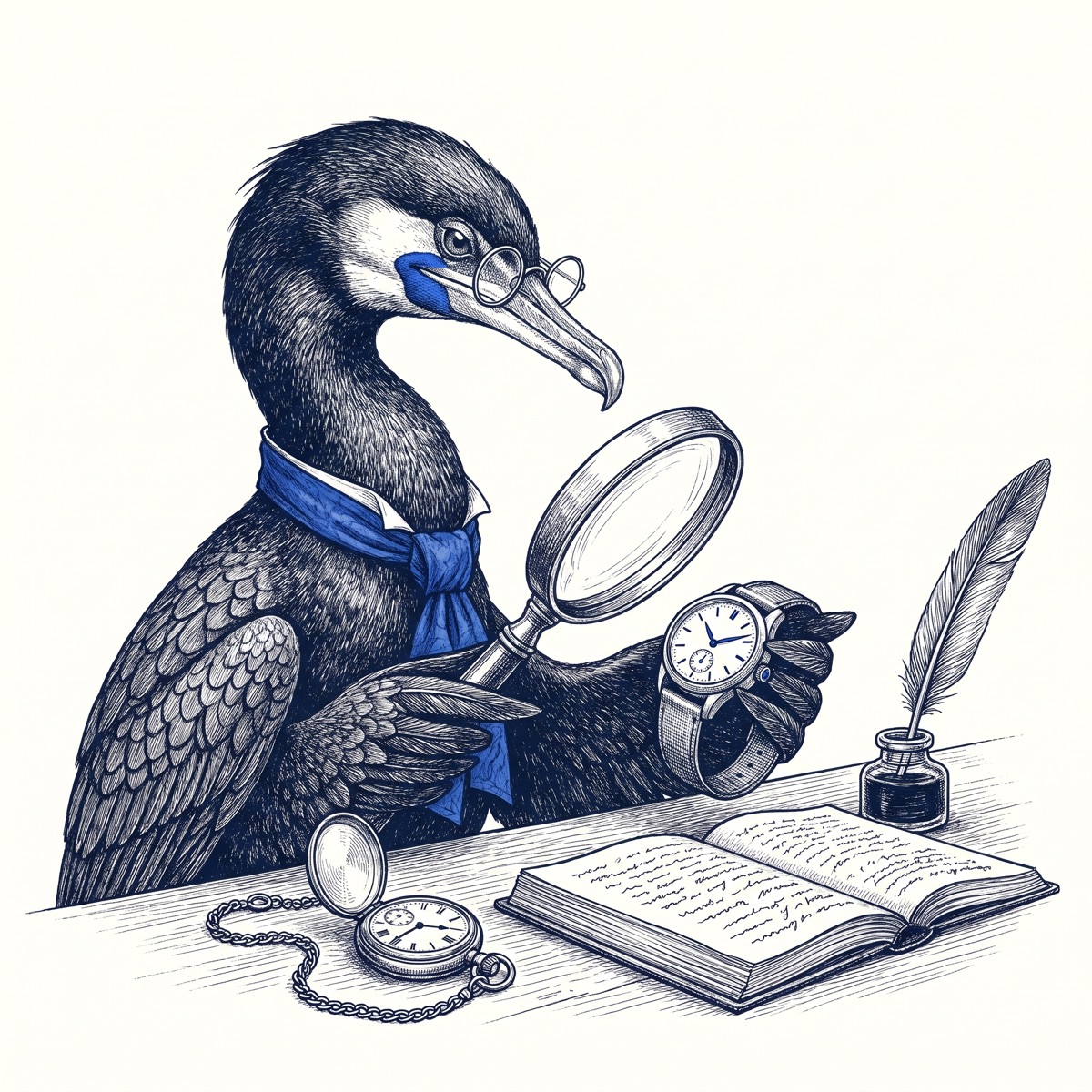
Why they feel period-correct
An anachronism is not a lapse in knowledge. It is a lapse in prompting. Nothing about the wristwatch flags itself as modern: it reads as old-fashioned, the scene is old-fashioned, and your eye slides past. Men carried pocket watches into the 1910s, and the wristwatch became normal menswear only through the First World War, when officers needed a hand free. You knew that, or could have found it in a minute. You were never asked the question.
That is the whole shape of the problem. The errors that get past you are the ones your memory files as vaguely correct, and memory is precisely the instrument you are rereading with. A dedicated pass, run against sources rather than instinct, catches what four rereads will not.
The five traps
Period errors cluster. Knowing the categories tells you what to interrogate:
- Objects and technology. The obvious one, and still the most common. Friction matches, safety razors, aluminum foil, ballpoint pens, sliced bread, and antibiotics all have hard start dates. Penicillin was a wartime miracle produced at scale for troops by 1944, not something a village doctor prescribed in 1935. Anesthesia has a public debut you can name: ether, Boston, 1846.
- Language. The hardest trap, because dialogue is where writers relax. "Scientist" was coined in the 1830s; before that your natural philosopher is a natural philosopher. "OK" is first attested in a Boston newspaper in 1839. "Teenager" is a 1940s word for a category that barely existed as a social identity before then. Whole registers are dated: therapy vocabulary is largely twentieth century, and "passive-aggressive" arrived through mid-1940s military psychiatry.
- Brands and proper names. Brand names feel timeless and are not. Band-Aid is 1920, Kleenex 1924, Tupperware 1946. Company names, country names, street names, and building names all move. A character cannot post a letter to a nation that has not been founded.
- Institutions and social norms. What a police force could legally do, what a woman could sign her own name to, how a marriage ended, who could vote, what a diagnosis was called. These are the anachronisms that reviewers notice and readers argue about, because they change what a scene means rather than just what it contains.
- Money, measurement, and time. Prices and wages are period detail like any other. So is the clock: before the railways imposed standard time, towns kept their own local solar time, and the United States and Canada only switched to standard railway time zones in November 1883. A character catching a train "at noon" in 1870 is standing inside a genuinely different idea of noon.
The anachronism you make backwards
Writers spend so long guarding against modern things arriving early that they commit the opposite error: assuming the past was emptier than it was. Spectacles were in use in Italy by around 1290. A machine that transmitted images down a wire was patented in 1843, more than thirty years before the telephone, so the fax is older than the phone call. Coffee houses were a fixture of European city life through the seventeenth century, which is why your 1890s detective can have his coffee after all.
This matters beyond trivia. Writing the past as a poorer version of now flattens it, and flattening is a worse failure than a wrong date because a reader cannot point at it. Research the abundance as carefully as the absence. Our guide to researching historical fiction covers where to go looking.
How to run an anachronism pass
Do not fold this into a general edit, where it hides. Run it as its own pass, late, when the draft has stopped moving:
- Inventory the scene. Go through one scene at a time and list every concrete noun a character touches, wears, rides, eats, or reads. Add every institution named and every number quoted. A page usually carries a dozen datable claims.
- Date each one against a source. Not memory, and not a chatbot's memory, which fails in the same direction yours does. You want something you can point at later.
- Read the dialogue separately, for vocabulary only. Different pass, different eyes. Idiom and metaphor count: a character cannot describe anything as being like clockwork before mechanical clocks, or say a plan has too many moving parts before machines that had them.
- Follow the ripple. Fixing one date often breaks a neighbor. If the war starts a year later, the character's age, the harvest, and the letter that arrives too late all shift with it.
- File the receipt. Keep the source beside the fact. When a copy editor queries it in eight months, the answer is already written down, and you will not re-research the same question twice.
Check a scene for anachronisms before you start the full pass: paste up to 1,500 words into the free anachronism checker, no signup needed. It returns cited findings, and the AI writes no prose.
Dating a word without guessing
Two questions, not one. First: did the word exist? A historical dictionary such as the Oxford English Dictionary gives you the earliest attested use, with the quotation it comes from. Second, and more useful: was it ordinary? A word can be technically attested in 1850 and still be wrong in the mouth of a 1850s farmhand. The Google Books Ngram Viewer will show you roughly how common a term was in printed books decade by decade, and a newspaper archive shows you how people actually wrote when they were not being literary. Treat the deep end of any corpus with suspicion: scanning and dating errors make pre-1800 counts noisy.
One warning about the shortcut. Asking a general-purpose AI whether a phrase is period appropriate produces a confident answer built from the same haze that let the phrase in. Confidence is not evidence. Insist on a citation, then read it.
Breaking it on purpose
Deliberate anachronism is a legitimate technique. Plenty of good period work uses modern diction so audiences hear the characters as people rather than as costumes. The rule is that a broken rule has to look chosen. Consistency is what signals intent: one modern idiom in an otherwise scrupulous 1790s script reads as a mistake, while a whole register of modern speech reads as a decision. Choose the level of anachronism you are working at, write it down, and hold the line. That decision belongs in your story bible next to your world rules, so it survives the months between drafts.
How Storskarvia helps
Storskarvia never writes a word for you, which is exactly why it is useful here. Check Facts reads your draft, pulls out the checkable real-world claims, verifies each against retrieved evidence, and then hands every finding to a second reviewer, the Skeptic, whose only job is to tear it apart before you see it. What survives reaches you as a punch list with quotes and citations, or as one quiet line: "No issues found." There is no praise channel; it is structurally unable to compliment you.
Research covers the other half: highlight a passage, ask when the thing actually existed, and the cited answer is filed into the project's Research library where you can find it again. Your Story Bible holds the period rules you have settled, and the continuity editor keeps the draft honest about them, which is the neighboring discipline to this one. Every fix stays yours to make.